|
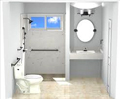
Our "aging in place" bathroom features are extensive with many options to choose from. Highly customized configurations that perfectly accommodate individual preferences and requirements can be created. The major design options are presented below:
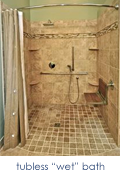
- "Wet" vs. "dry" bathrooms. Many apartments that seniors prefer to age in have bathrooms that are too small to accommodate wheel chairs but lack non-load bearing walls that could be reconfigured to gain more space. Tub-less or "wet" baths, baths that only have a shower and not a tub, are potential solutions to this problem.
The shower area in these bathrooms have curb-less entries that permit wheel chairs to roll into, they have adjustable, hand held shower heads, they have grab bars to assist in movements, and can have built-in seating as well.
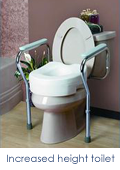
- Raised toilet seat heights. Toilets with higher seat levels will make it easier for people who have difficulty with bending or stooping to use the toilet. If desired, standard toilets can be converted to higher seat levels by attachments made for this purpose.
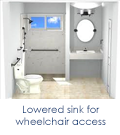
- Lowered lavatory console heights. Lavatories and commodes are available with lowered heights and open spaces beneath to accommodate wheel chair users. Lighting, medicine cabinets and towel bars can be lowered proportionately as well.
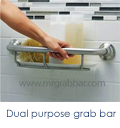
- Grab bars. There is a tremendous variety of grab bars on the market today. They come in all sizes, shapes, materials and colors to provide coordination with other design elements in the bathroom.
A word of caution: grab bars must be installed with adequate blocking in the walls they're attached to, providing the capability to withstand the tug of a 300-pound person without being pulled off the wall.
- Non-skid flooring. According to the Center for Disease Control and Prevetion, two thirds of all bathroom injuries occur in the bath and shower areas. Such injuries have the potential to be life threatening, especially for the elderly who tend to make up the majority of the victims.
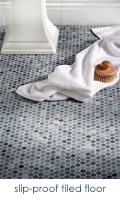
Bathroom flooring must satisfy multiple requirements. It must be moisture proof, stain resistant, have a non-skid surface that's safe even when wet, and be durable enough to stand up to heavy foot traffic, In addition, the flooring must be available with enough options to be well coordinated with the bathroom's general decor.
Rubber bathroom flooring is an easy solution because it's durable, slip resistant and easy to clean. This type of flooring is a cost-effective to bring adequate safety to your bathroom. However, its appearance has an industrial flavor that many will find unsuitable for residential applications.
Glass and glazed ceramic floor tiles with an anti-slip finish are designed to provide superior traction. Tiles can be found that are rated to meet slip-restant standards specified by the Americans with Disabilities Act. And, there are countless design options on the market making it easy to achieve decor coordination.
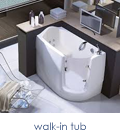
- Walk-in Tubs. Traditional bathtubs often present a risky situation for aging seniors or people with mobility issues. Entering and exiting a bathtub are times when many mishaps occur. walk-in tubs an be an easy solution to this problem. These special tubs, which typically have doors that open and close, are coming into increasingly wide use, but they can be expensive, and their pros and cons should be understood before making a purchase.
The first and most obvious advantage is that a walk-in tub makes bathing easier for people with mobility issues. In addition to the door, these bathtubs are designed to prevent slipping. Grab bars, seats and textured pads help users keep their heads above water.
Walk-in tubs eliminate the need for a sliding glass shower door, which poses a serious danger for seniors. Some seniors use these doors for stability or balance, which is a bad idea, because these doors were not designed to withstand their weight.
There are some disadvantages to walk-in tubs. First, the bather must enter the tub and shut the door before turning on the water. Besides becoming impatient (and possibly chilly) while the tub fills, there could be some difficulty in getting the right water temperature.
Waiting for the bath water to drain before the tub can be exited is another disadvantage to be considered. Many of manufacturers have addressed this issue by designing fast fill faucets, fast draining rates and water temperature controls, but these additional features drive up the product price.
Typically, walk-in tubs are priced in the range of $2,500 to $10,000.

|
|